

Residential Fellowships
Fellowships offer scholars the time, space, and support they need to pursue their work and the opportunity to take part in the Center’s vibrant intellectual community.
Is this the right fellowship for me?
The National Humanities Center’s Residential Fellowship is one of the most prestigious humanities fellowship programs in the world. Fellows enjoy a beautiful and serene space to write, unparalleled library and reference support, excellent dining services, and a stimulating and supportive intellectual community.
A key feature, meanwhile, that differentiates us from many other fellowships is our residential requirement. Researchers are especially encouraged to apply when they expect to benefit from, and actively contribute to, an in-person community of other humanities researchers. If you prefer a research fellowship that allows you to do field work or to work in your own local space, this may not be the fellowship for you.

Learn more about the amazing scholars who benefited from NHC fellowships, and the projects they have developed while in residence.
Special Support
Unique Fellowship Opportunities
Thanks to generous support from funders and partners, the Center is able to offer dedicated fellowship support for faculty from HBCUs, scholars of early modern China, early-career female philosophers, scholars at risk, and international applicants.
Opportunities for Scholars from HBCUs
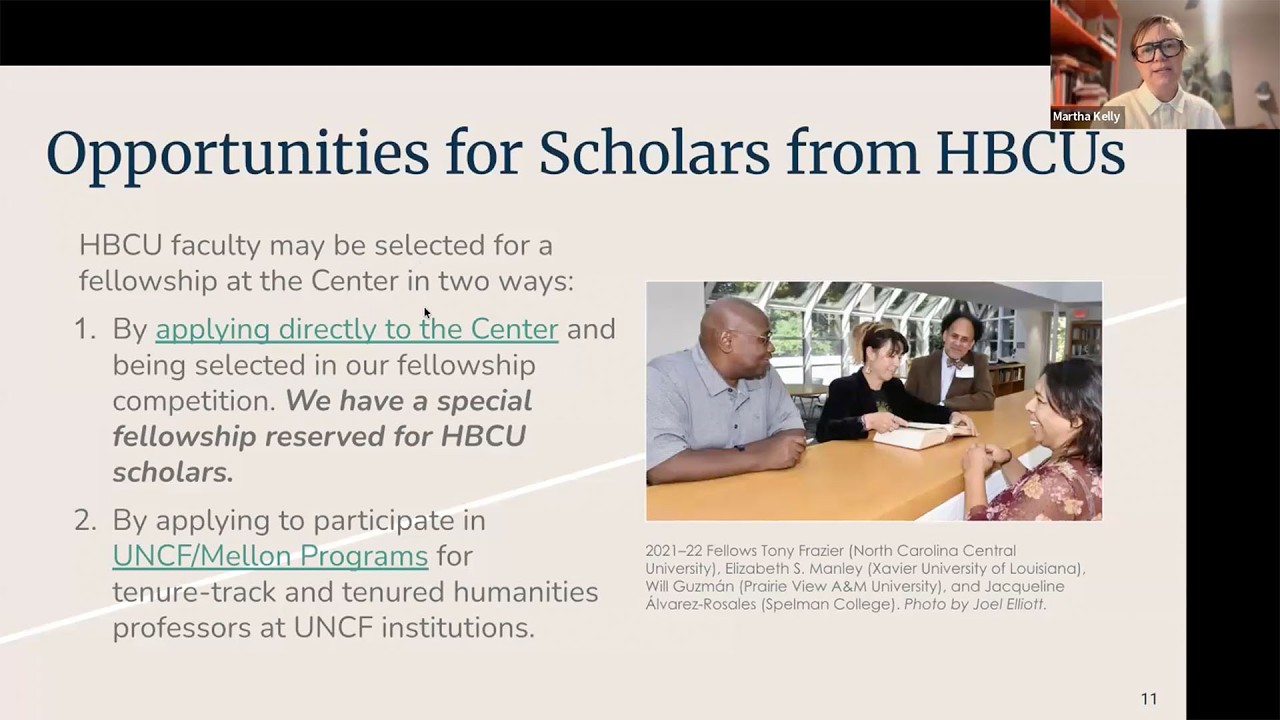
HBCU faculty may be selected for a fellowship at the Center in two ways:
- First, by applying directly to the Center and being selected in our fellowship competition.
- Second, by applying to participate in UNCF/Mellon Programs for tenure-track and tenured humanities professors at UNCF institutions.
Note: applicants who are eligible for the UNCF/Mellon program may also apply concurrently through the Center’s fellowship competition.
Webinar
NHC Fellowships for HBCU Faculty
This webinar recording features the NHC’s Vice President for Scholarly Programs Martha Kelly (NHC Fellow, 2022–23), NHC President and Director Blair LM Kelley (NHC Fellow, 2022–23), and Jennifer Williams of Howard University (NHC Fellow, 2019–20) discussing the NHC fellowship experience, tips for writing strong proposals, and advice on getting support from your institution.
Scholars from HBCUs Applying Directly to the Center
In addition to meeting the general eligibility requirements of the fellowship competition, applicants must hold a continuing appointment (tenure-track, tenured, or continuing lectureship position) at an HBCU at both the time of the application and during the fellowship year/semester. Interested applicants must apply directly to the Center via our online application. Each year, the fellowship competition opens on July 1 and closes in early October.
To be considered for this program, applicants must select that their institution is an HBCU when prompted in the online application system to identify the type of institution with which they are affiliated. Applicants may apply for a residential fellowship for the fall semester (September through December), spring semester (January through May), or academic year (September through May).
Scholars from HBCUs Applying to the UNCF/Mellon Program
The Center has also partnered with the UNCF/Mellon Programs to provide an opportunity for UNCF faculty members for a one-semester fellowship at the Center. The UNCF/Mellon Programs were created in 1989 with a grant from the Andrew W. Mellon Foundation. The programs are designed to create faculty career enhancement opportunities for faculty teaching at UNCF institutions.
Within the suite of career enhancement opportunities for UNCF faculty is the Faculty Residency Program. Applicants to the UNCF/Mellon Program who are interested in being in residence at the National Humanities Center should indicate their interest on the UNCF/Mellon application. No prior approval from the Center is needed.
Tenure-track and tenured humanities professors at the consortium of thirty-seven UNCF institutions and Hampton University are eligible to apply. The deadline to submit a UNCF/Mellon application is January 31. To learn more about eligibility and the application process and to apply to the program, please visit the program website.
Opportunities for Scholars Studying Early Modern China
The National Humanities Center welcomes fellowship applications from scholars engaged in the study of China and its world, during and adjacent to the Ming dynasty (1368–1644).
The Center is pleased to hold a partnership with the James P. Geiss and Margaret Y. Hsu Foundation to provide residential fellowship support to a scholar engaged in the study of China in the Ming dynasty (1368–1644), or of regions and time periods adjacent to the Ming. Established in 2001, the James P. Geiss and Margaret Y. Hsu Foundation encourages and supports scholarly research and interpretation of imperial China during the Ming dynasty (1368–1644), as well as its immediate predecessors and successors, and of contemporaries in geographic areas with which the Ming interacted.
Emerging scholars, mid-career scholars, and senior scholars working in the designated areas may apply for a residential fellowship for the fall semester (September through December), spring semester (January through May), or academic year (September through May). Interested scholars must apply directly to the Center via our online application. Each year, the residential fellowship competition opens on July 1 and closes in early October.
Opportunities for Early-Career Female Philosophers
Since 2011, the National Humanities Center has been privileged to offer dedicated fellowship support each year to a female philosopher in the early stages of their scholarly career through the Philip L. Quinn Fellowship.
The Quinn Fellowship was established through a gift from the Estate of Philip L. Quinn to honor the late University of Notre Dame philosopher and further his commitment to improving gender diversity in the field of philosophy. While never a Fellow himself, Quinn believed deeply in the value of the Center as a crucial institution for nurturing scholarship in the liberal arts and for helping early-career scholars develop their careers.
Eligibility for the Philip L. Quinn Fellowship is rooted in an inclusive understanding of womanhood. Women working in any sub-disciplinary area of philosophy are encouraged to apply.
All applications are reviewed through the general pool.
At-Risk Scholars at the National Humanities Center
As part of its ongoing commitment to academic freedom and in response to a global refugee crisis, the National Humanities Center, in partnership with Duke University and the Institute of International Education’s Scholar Rescue Fund, is working to support threatened and displaced scholars.
The Center and its partners have funded a number of at-risk and refugee scholars by providing them a haven to pursue their work in safety and in an environment designed to foster scholarly excellence.
Scholars selected as a part of this program will be granted up to two years’ status as Visiting Scholars at Duke University and as Resident Associates at the Center, allowing them the opportunity to conduct their research and enjoy the benefits afforded other members of these scholarly communities.
Interested scholars are encouraged to apply directly to the Scholar Rescue Fund and may contact the NHC Scholarly Programs staff for more information.
The National Humanities Center is also a proud member of the Scholars at Risk network. For more information about the SAR network, please visit their website.
For the purposes of this program, “at-risk scholar” is defined as anyone who has left their home country or country of residence due to war, political persecution, or threat of persecution and who has not gained asylum or citizenship in another country.
If you would like to make a gift to the At-Risk Scholars program, please visit our support page.
Fellowship Information for International Applicants
The National Humanities Center welcomes fellowship applications from scholars engaged in advanced humanities research regardless of citizenship or national origin. Each year, several scholars from countries other than the United States come to the Center as part of the cohort of Fellows and contribute to the rich intellectual and diverse environment of the fellowship program.
International applicants must meet the general eligibility requirements of the fellowship competition, and should consult our Frequently Asked Questions for additional information.
Fellowship recipients who come from overseas are provided with guidance in securing housing, arranging local transportation, and finding schools to assist in their transition. The Center reimburses round trip travel expenses for the Fellow and those family members who will live with the Fellow during their time in North Carolina.
The stipend amounts awarded are individually determined, according to the needs of the Fellow and the Center’s ability to meet them. The Center seeks to provide half salary with the expectation that the Fellow’s home institution covers the remaining salary.
The Center sponsors J-1 (Research Scholar) visa applications for its Fellows who are not U.S. citizens, and can also provide J-2 visas for spouses and children. For more information, visit J-1 Visa Programs.
About the Process
Application Components
The National Humanities Center welcomes applications to its Residential Fellowship. Mid-career and advanced scholars are especially invited to apply. For more information, please see the Application Eligibility Checklist, the Applicant Eligibility Checklist, and our FAQs.
Overview
The Center will begin accepting applications for the 2028–29 academic year on July 1, 2027 with a deadline of October 1, 2027. Fellowship applicants are asked to complete the online application and to upload the following documents (please see specific guidelines below):
- 1,000-word project proposal
- short bibliography
- brief curriculum vitae
- one-page tentative outline of the structure of the project
Applicants must also provide names and contact information for three references. References will receive an email prompt inviting them to upload a letter of recommendation on behalf of the applicant. All letters are due by October 8, 2027. The remaining application elements are due October 1.
Once applications are submitted, changes can no longer be made, by either the applicant or the NHC.
Project Proposal
1000 words maximum; 11- or 12-point font with margins no smaller than one inch.
The Center welcomes applicants who are working on a substantial humanistic scholarly project that is at an advanced stage. While most projects are single-author scholarly monographs, other forms of humanities research-based work are eligible. The Center is open to new forms and expressions of humanities scholarship. We consider a project to be at an advanced stage once most of the research is complete, and the scholar has begun writing.
Your project proposal should demonstrate the depth of your disciplinary and subject-specific knowledge, while also being clear to an interdisciplinary audience unfamiliar with your topic or the terminology of your field(s). A strong proposal will convey the importance of the project for advancing knowledge both within a scholar’s own field and for the humanities more generally.
In your proposal, be sure to address the objectives and scholarly significance of the proposed research, as well as the sources and methodology to be used. Applicants should distinguish what will be original about the proposed work in contrast to existing publications on the subject.
In the concluding paragraph of the project description, applicants should summarize the present status of their research, including how much has been done in relevant collections and archives, and what they would hope to accomplish at the Center. Proposals that do not explicitly address their project status and projected timeline will be deemed ineligible.
Bibliography
Two pages maximum; 11- or 12-point font with margins no smaller than one inch.
Include the works most relevant to your project, whether as a basis for your approach or a counterpoint. Reviewers look for evidence of your preparedness to successfully complete your project. For all projects, but especially interdisciplinary ones, we recommend including key texts for your subject or topic from each relevant discipline, in order to demonstrate your awareness of the major conversations around that topic. Be sure to include any works you reference in your project proposal.
Curriculum Vitae
Four pages maximum; 11- or 12-point font with margins no smaller than one inch.
Your curriculum vitae cannot exceed four pages. Application reviewers may rank a project lower when a longer, less-focused CV is provided.
Include relevant educational and professional experience and a representative list of publications. Be sure to include previous book-length publications such monographs, co-authored volumes, and edited volumes.
NHC Fellows are chosen based not on their record of past achievements, but on the strength of their project proposal and its supporting documents. Think of the brief CV less as an opportunity to highlight all your achievements and more as a chance to demonstrate past experience and publications that position you well to execute the specific project for which you are applying.
Tentative Outline
One page maximum; 11- or 12-point font with margins no smaller than one inch.
For a book project, provide a chapter outline indicating the purpose of each chapter. For other major projects, describe the structure of the project and indicate the stage of completion, or the projected completion date, for each section or module proposed. Projects not indicating stage of completion will be deemed ineligible.
Letters of Recommendation
Letters of recommendation should specifically address the merits of the project and the scholarly qualifications of the applicant for a fellowship at the Center. The most effective recommendations are from scholars who already know the applicant’s work well and can speak to its significance. These letters are more effective than one from a famous scholar who does not know your work well.
It is wise to include references who do not work at the applicant’s place of employment and who were not on the applicant’s dissertation committee. It is acceptable to include committee members, but it is often less strategic to include only committee members. For international applicants, letters of recommendation from scholars with experience at US, British, or European research institutions can help contextualize a candidate’s preparation for a residency at the National Humanities Center.
Eligibility Checklists
Application Eligibility Checklist
All materials are due October 1, 2027, except for letters of recommendation, which are due October 8.
- Project proposal (1,000 words maximum; 11- or 12-point font with margins no smaller than one inch). The proposal must note the current stage of project and projected timeline to completion.
- Bibliography (two pages maximum; 11- or 12-point font with margins no smaller than one inch).
- Curriculum vitae (four pages maximum; 11- or 12-point font with margins no smaller than one inch).
- Tentative outline of project (one page maximum; 11- or 12-point font with margins no smaller than one inch). The outline must note the current or projected completion stage for primary components of project.
- Three letters of recommendation (due October 8, 2027).
Applicant Eligibility Checklist
Please note that we have no citizenship requirements. International applicants are warmly invited to apply.
- The applicant holds a PhD or relevant terminal degree for their primary discipline (e.g., MFA for research-based non-fiction writers).
- The PhD or requisite terminal degree was received at least five years prior to October 1, 2027 (i.e., no later than September 30, 2022); or the applicant meets the requirements for one of two unique fellowships: 1) Geiss-Hsu Fellowship, for a project substantially addressing Ming-era China, possibly including adjacent eras; 2) Philip L. Quinn Fellowship, for a female-identified early-career philosopher.
- The applicant has published at least one scholarly monograph, for book-focused fields, or the equivalent in peer-reviewed scholarship for article-focused fields.
- The applicant is working on a project beyond the dissertation.
- The applicant is engaged in humanities research that will result in publication.
- The applicant’s project is grounded in one or more humanities disciplines, or it is grounded in other fields (the natural and social sciences, the arts, the professions, and public life) but substantially employs humanistic approaches and methodologies.
- The proposed project is at an advanced stage, meaning that most of the research is done, and the applicant is already writing.
- The applicant plans to spend the full term (one or two semesters) in residence at the Center. Extended time away, including trips for field research, is not permitted.
- The applicant speaks and reads English fluently. It is not required that the primary project publication be written in English.