
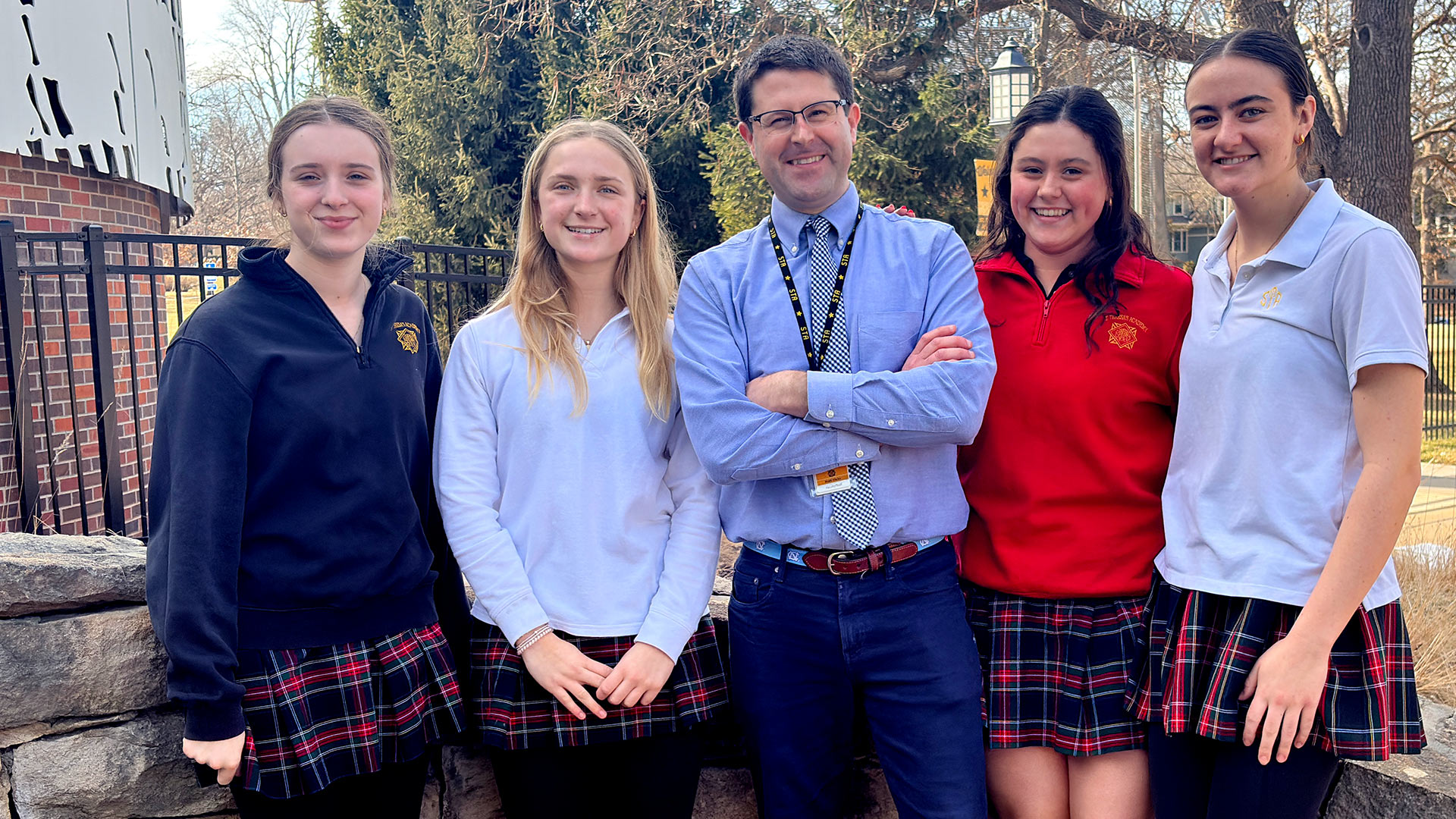
Lighting the Flame
Matt Hicks
High School English Language Arts Teacher
NHC Teacher Advisory Council Member
Myra admits she became more than a little nervous last year during her sophomore World Literature class at St. Teresa’s Academy, a private, all-girls Catholic school in Kansas City, Missouri.
Her teacher Matt Hicks tasked Myra and her classmates with an assignment beyond their comfort zone. “At first when he started explaining it, I was like, ‘This is going to be really difficult,’” recalled Myra. “And it was really difficult. He was like, ‘Look, you’re going to get out of this what you put into it.’” Hicks charged his students with identifying a problem, exploring it from different angles, and producing a podcast to present one solution–conceding nothing is perfect–as better than others. He crafted the assignment in part from a National Humanities Center webinar class for educators.
Currently in his twenty-fourth year of teaching, Hicks wants to light a fire within his students—a fire for knowledge, and for bettering humanity and themselves. A teacher passed the education spark to Hicks when he was 14 years old, attending Saint Louis University High School, an all-boys Jesuit high school, with no plans to be an educator. “I remember my freshman English teacher,” said Hicks. “His name was Father Richard Hadel, S.J. He said, ‘What do you want to be when you grow up?’ And I said, ‘I want to be rich.’ He chuckled and said, ‘I think you’d be a really good English teacher.’”
The idea sparked a small ember that grew into a flame. “He believed in me before I ever believed in myself,” said Hicks. “That was such a transformational experience in my life. I still thank this man to this day. Because of that man, I understand how transformational education can be. He looked at me as a human. He would ask about my family. He made me feel like a person.”
I’m not asking kids anymore, ‘What do you want to be when you grow up?’ I’m asking them, ‘What problems do you want to solve?’
Hicks prepares sophomores for their junior year of AP Literature. His lesson plans include elements from the National Humanities Center’s classroom resources. He also incorporates what he learned while attending and assisting with two NHC-sponsored Artificial Intelligence and Digital Literacy (AIDL) programs, an institute at the University of Tulsa and a summit at Consumer Affairs in Tulsa. “We want to be the humans in the world leading other humans in this AI endeavor,” said Hicks.
As a member of the NHC’s 2024-25 Teacher Advisory Council (TAC), Hicks has also attended and assisted with the NHC’s Humanities in Class Webinar Series for teachers. As part of the TAC—the NHC’s leadership program for educators—members evaluate the Center on the development of its webinars, educational materials, and summer institutes (virtual and in-person). Free webinars, providing interdisciplinary humanities content, run September through May and draw 800 to 900 attendees during each of the live sessions, 23 during 2024–25. “These are teachers who want to interact with the scholars, but who are also delving into these complex topics that often are not discussed in their district,” explained Mike Williams, the NHC’s vice president for education programs.
Hicks embraces the tools that not only engage his students but also ignite their passion for learning and building intellectual community like the one he has found at the NHC. “I really believe in community and that we are a social people,” said Hicks. “We are standing on the shoulders of giants, and we are trying to put that next generation on our shoulders.” He wants those future shoulders to be shored up with critical thinking that includes hearing all perspectives and using technology to enhance, not harm, the humanities.
Creating New Knowledge
For student Myra and her project partner Claudia, that meant examining AI through academic articles and statistics, then turning their research into a five-minute podcast. It was a tall task that scared Myra into her initial reaction when Hicks introduced their assignment. “Our topic was about AI’s role in disinformation and misinformation,” explained Claudia. “In Mr. Hicks’s class, I feel like my understanding of what English is, and what literature is, was really pushed. It tested me because often we think of literature as a book, and writing an essay about a book, and following this kind of formulaic idea. When we did the podcast project, it was a reality check that literature is impactful because it relates to the real world. It encourages you to think about how what you’re reading applies in a modern context or even a historical one.”
Hicks gave his students intellectual space and guidance at the same time. “When Myra and I were doing our project, I felt supported by Mr. Hicks,” said Claudia. “He was helping guide us through the technical side but also the problem-solving and thinking side. I gained the ability to take in information, but then also create an output from what I’m getting. I feel like that was what the podcast project was really about.”
Claudia’s classmate Clare also researched AI but from a different angle. “My podcast was about how AI can lead to over-personalization of different apps and higher screen times and isolation,” said Clare. “It is sometimes hard for people to have actual conversations. I think that’s a theme we picked up along the way in Mr. Hicks’s class was that he focused a lot on the communities.”
The classroom projects led to community-building while also building the students’ confidence to create new knowledge, one of the NHC’s key tenets. The project ended, but their curiosity regarding AI’s impacts was just beginning. “This last year, I led an AI interim to see how AI plays into education,” said Clare. During the short interim between first and second semesters, students and teachers step beyond the normal curriculum to innovate, create, and discover. Clare continued her examination of AI. “It’s definitely something that I wouldn’t have been as confident going into, or ever would have thought of without that podcast project, because we did so much research with it. It’s like a byproduct. These things are not only what we’re creating, but what we’re pushed to do after.”
I don’t think the leader has to be in front. The leader just has to be with you in carrying the fire. You never really know when that transfer of the fire is, but it becomes a legacy.
St. Teresa’s Academy senior Drew will be majoring in biochemistry at the University of Vermont in Fall 2026, and she hopes to conduct developmental pediatrics research. Drew reached into the local community to complete her podcast assignment with a project partner. “How can we create inclusive spaces for individuals with disabilities at St. Teresa’s Academy, where we don’t have a special education program and we don’t talk about the language that you’re supposed to use, and how to go about interacting with individuals with disabilities?” said Drew. “My podcast was wonderful. I had a blast doing it also because it is what I love doing. It gave me the freedom to work with a community that I love and that I already am into outside of school and build that into school. Then we ended up making posters. It gave me this sense of, if Mr. Hicks thinks I can do it, I can. Now I’m an ambassador and a leader at PALS, a program for individuals with Down syndrome. It’s honestly inspiring because he is the reason that I pushed myself to go and do all this extra stuff that really made me who I am and allowed me the space to grow in this community that I have so much love and passion for.”
The assignment took students from nervous to curious. “School needs to be a place where kids feel empowered to learn and grow,” said Hicks. “But I’m giving them first-hand experience into deciding what sort of problems they want to solve.”
Building Community
It’s no surprise that the English teacher leans into metaphors to describe how educators influence the future. “I’m a glowing ember of Father Hadel, a glowing ember of the TAC and the people that I got to be friends with in the TAC, and I’m a glowing ember of Mike Williams at the NHC,” said Hicks.
“Matt lives that,” said Williams. “Matt has a passion. Matt is one of those teachers who exists between joy and justice, those two pillars. Whether he’s leading a conversation among his colleagues or leading a session for an institute, his passion is unparalleled for this work. He’s always thinking about how does this high-end scholarship work, and how does it translate to the classroom with my students? I appreciate what Matt brings to the table.”
“It feels really good to be noticed and to be seen,” said Hicks, “and when you walk in those doors at the Center, Mike always says, ‘You’re a big deal around here.’”
The experiences and opportunities with the NHC allowed Hicks to make meaningful and productive connections with other educators. From using NHC classroom resources, to participating in the Artificial Intelligence and Digital Literacy 2025 Teachers Institute, and attending the “How to Disagree Agreeably” conversation between scholars Cornel West and Robert George (moderated by PBS News Hour foreign correspondent Jane Ferguson), Hicks found community. “It’s all because of the NHC. They created this community for me. Now my community is a national experience. Teaching is long hours, it’s hard. But if you can have a day-to-day belief and you take that distant fire and you make it a daily fire, you really feel alive and glowing. Then I can be an even better and greater version of myself. That’s what the NHC does. No matter what’s going on in the world, you know that you have somebody with you carrying the fire.”