
Embracing Curiosity and Inspiring Courage
A Conversation With Kathleen DuVal and Blair LM Kelley
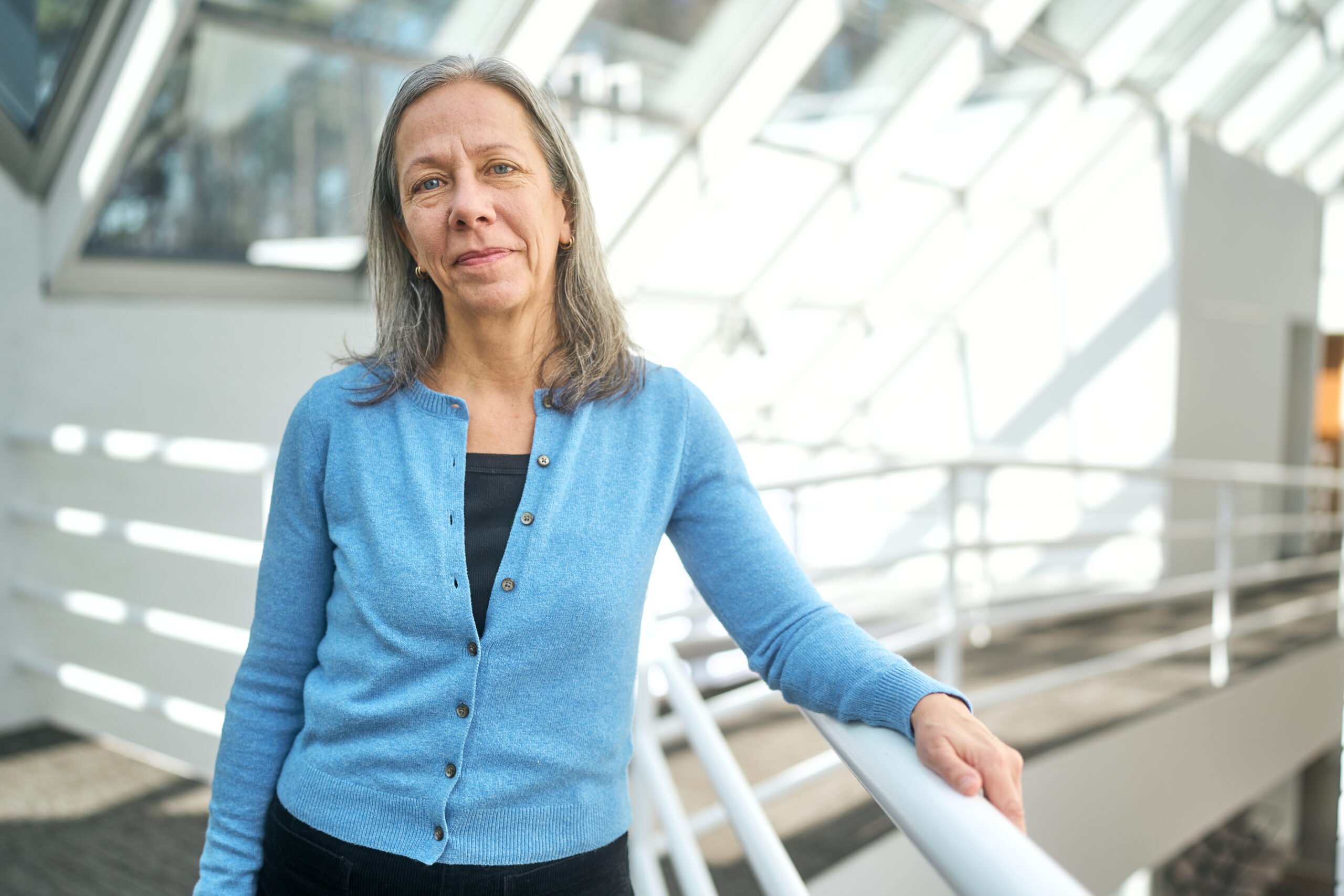
Kathleen DuVal (NHC Fellow, 2008–09; 2025–26), Carl W. Ernst Distinguished Professor of History, University of North Carolina at Chapel Hill
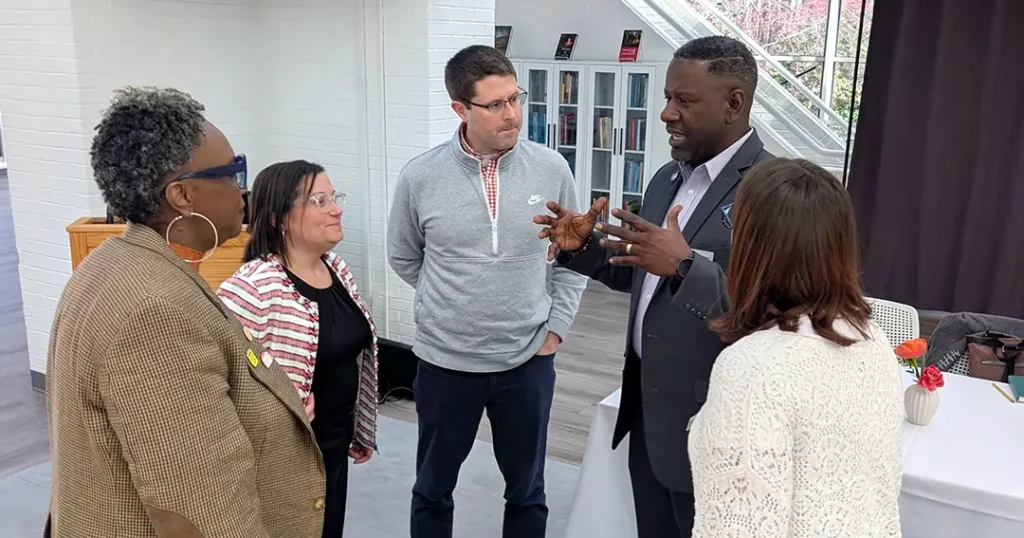
An impromptu conversation between prize-winning historians as they grab lunch or coffee in the National Humanities Center’s sunlit atrium is not unusual. Such encounters are what make the NHC a unique incubator for sparking ideas and creating community. What began as an informal chat progressed to an interview between NHC President Blair LM Kelley and NHC Fellow Kathleen DuVal, whose book Native Nations: A Millennium in North America won the Pulitzer Prize in History in 2025, as well as the Bancroft Prize, the Cundill History Prize, and the Mark Lynton Prize. This unprecedented achievement demonstrates the robust scholarly rigor Fellows bring to and share with the National Humanities Center.
In her book, DuVal tells the story of Native peoples “adapting to change in the Americas for at least 20,000 years and counting.” She wanted readers to know there is more to Native American history than limited ideas of Indian removal and traumatic boarding schools. In this interview, DuVal, a two-time NHC Fellow (2008–09 and 2025–26) and Guggenheim Fellow, talks about what she describes as the complicated and beautiful history of Native peoples who continue to adjust and adapt to change. DuVal also shares how the classrooms and students at the University of North Carolina at Chapel Hill influence her work.
This excerpt shares a small portion of the conversation about DuVal’s work, her inspiration in the classroom, and the motivation to keep pressing for more voices, information, and understanding.
Blair Kelley: I want to start by asking you to read a sentence from your foreword that I think encapsulates the book really well. It’s on page sixteen.
Kathleen DuVal: “They live in history, adapting to change in the Americas for at least 20,000 years and counting.”
BK: What does that sentence mean to you?
KD: I think for so many non-native Americans, it means a couple of things that we’ve learned along the way about Native American history. It might be Indian removal, or it might be the boarding schools. It’s almost certainly going to be something bad and something about the maybe rapid decline of Native peoples. I wanted to tell a story that’s longer than that. I think nobody wants to be known only by bad things that happened to them. Even if they’re really, really bad. I think that’s true for large groups of people as well. Native American history is so long and complicated and beautiful, like all human history with all its downsides and upsides, and it’s still continuing. So that’s my “and counting” there at the end. Because probably the worst part of that misunderstanding of Native history is that too often we think of Native peoples as just being in the past. Yet, Native Americans are still here, obviously, but also Native nations are still here.
I could almost say this about my whole career—it’s impossible without being in the classroom.
DuVal describes how teaching the humanities, being immersed in the classroom with curious students asking questions, provided her with the confidence to approach a historical topic of such enormity.
BK: We’ve known each other the whole time we were on faculty. I was at North Carolina State University and you were at the University of North Carolina at Chapel Hill. I’m so excited to talk with you about your work because I think it’s really grounded in your experience as a teacher.
KD: That’s right. In this latest book—and I could almost say this about my whole career—it’s impossible without being in the classroom. I think for me, particularly being at UNC, it has just been part of making me who I am, and part of making my work what it is. This particular book, the sort of hubris of thinking I could write a thousand years of history, actually comes from a class. My very first class, my very first semester at UNC, I was assigned to teach Native North America. This class, in one semester, is supposed to span actually more than a millennium, from the beginning of time to today in Native history. It was just completely overwhelming my first semester. But I’ve come to love that the class teaches every student that Native nations have been here a long, long time and that they’re still here today. And that broad mandate of a huge time span is, I think, key to that class and something I wanted to take into this book, and give readers the same sort of experience that my students get.
BK: I ran into you in the NHC kitchen getting coffee one morning, and I said to you, “This is a big book. It has a boldness that I think is so powerful.” It’s an intercession into thinking that so many Americans have—as you said—that they know a little bit about Native history, and they think that’s sufficient. This book really turns that idea on its head and says, “No, I’m going to teach you all over again.” What gave you the confidence to do that?
KD: In some ways, I think maybe it was letting go of the idea that I needed to be the expert on everything to do that. One of the things I do is focus on a few specific Native nations, and I use those to sort of represent larger trends that were going on. But I hope the reader leaves thinking that they know less, not that they have learned less. Right? Realizing how little they know. I’ve got a long further reading section at the end to say, “Reader, go on and read more, please, because there’s lots more to learn.” Also, I make lots of suggestions about other ways to learn about Native history, such as going to various tribal cultural centers, or the National Museum of the American Indian, or other places where people can learn a lot more in a variety of ways. What’s really powerful in that process is often times, as a historian, I end up having that feeling of “Wow, I didn’t know that!” So, the more work you do, the more you realize, “I have more work to do.”
I think today there’s an unprecedented amount of material that’s available to all of us outsiders, and an eagerness for Native stories to be told in a variety of ways.
DuVal explains why the timing was right for researching and writing this book now as opposed to years prior.
BK: A lot of these histories have been kept close and secret a bit because there was a power in keeping your things to yourself and not having everybody know everything you thought or all of who you are. Can you talk a bit about writing as a person who’s outside of these nations and these communities, and our relationship to figuring out what to tell, what to share? What do these societies keep for themselves?
KD: I couldn’t have written this book twenty-five years ago, because Native nations were still just coming out from under the thumb of the federal government that had forced them to take so much underground and protect so much away from public sight. Now I think for so many Native nations, part of their renaissance that’s happening today is to decide what to bring back out. There are so many tribal cultural centers these days where they are telling their own history. Tribes are hiring not only a tribal historic preservation officer, but also many other kinds of scholars—linguistic scholars, historical scholars—who are mostly working for their own people, to tell their history to their own people, but also telling it to those of us outside.
I think today there’s an unprecedented amount of material that’s available to all of us outsiders and, certainly for the first time in a long time, an eagerness for Native stories to be told in a variety of ways, including in books that anybody can pick up at a bookstore, and also clearer guidance from tribes about what is totally fine to use and what’s not. Actually, a lot of books and articles have come out in recent years that are co-authored with tribal scholars and that are at least today’s “official accounting” of an oral history: “That’s the one you should use, outside scholar. If you want to use an oral history of ours, use this one today.” It feels very different from an earlier generation where a historian might want to use something besides printed documents. But the recorded oral histories, it was hard to tell if they had been taken in a responsible way. Was it okay to use them or not? Or they’re just completely misunderstood and wrong. I think there’s such a renaissance going on within Native nations, but part of that is about getting their story out in a variety of ways.
BK: Thank you for being one of the ways in which those stories can find audiences and find community, and hopefully change the way that we think about where we live and who we are as a people. We’re thrilled to have you here at the National Humanities Center. It’s an honor to have a scholar of your stature, but it’s also a gift to have someone who is open to this kind of conversation and part of this wonderful community of Fellows. Thank you.
KD: Oh, thank you, Blair. Thank you for this wonderful talk today, but also for having me here at the best place on earth.
Kathleen DuVal is the Carl W. Ernst Distinguished Professor of History at the University of North Carolina at Chapel Hill. Her field of expertise is early American history, particularly interactions among Native Americans, Europeans, and Africans. A Guggenheim Fellow, DuVal’s books include Independence Lost: Lives on the Edge of the American Revolution and Native Nations: A Millennium in North America, winner of the 2025 Pulitzer Prize for History. DuVal’s current project during her 2025–26 Robert D. Newman Fellowship at the National Humanities Center is Yorktown: The American Revolution and the Making of the United States.
Watch the entire conversation with Kathleen DuVal and Blair LM Kelley
Share this page
Latest News
Announcements
New Exhibit Focuses on “The Inner Passage” to Freedom
Sep 4, 2026
“The Inner Passage: Photographs by Virginia McGee Richards” will be on display at the National Humanities Center, September 8–May 28.
Announcements
National Humanities Center Names 2026–27 Teacher Advisory Council
Aug 4, 2026
The National Humanities Center (NHC) has selected 20 talented educators from across the country for its 2026–27 Teacher Advisory Council.
Announcements
Historian Martha S. Jones Joins National Humanities Center Board
Jul 29, 2026
Award-winning historian, legal scholar, and author Martha S. Jones has been elected to the National Humanities Center’s board of trustees.
Announcements
Ben Vinson III Re-Appointed as NHC Presidential Scholar-in-Residence
Jun 12, 2026
Dr. Ben Vinson III has been re-appointed as a 2026–27 Presidential Scholar-in-Residence at the National Humanities Center.