
Hitting All the Right Notes
Trisha Santanam
Emerging Scholar, Duke University
National Humanities Leadership Council Member
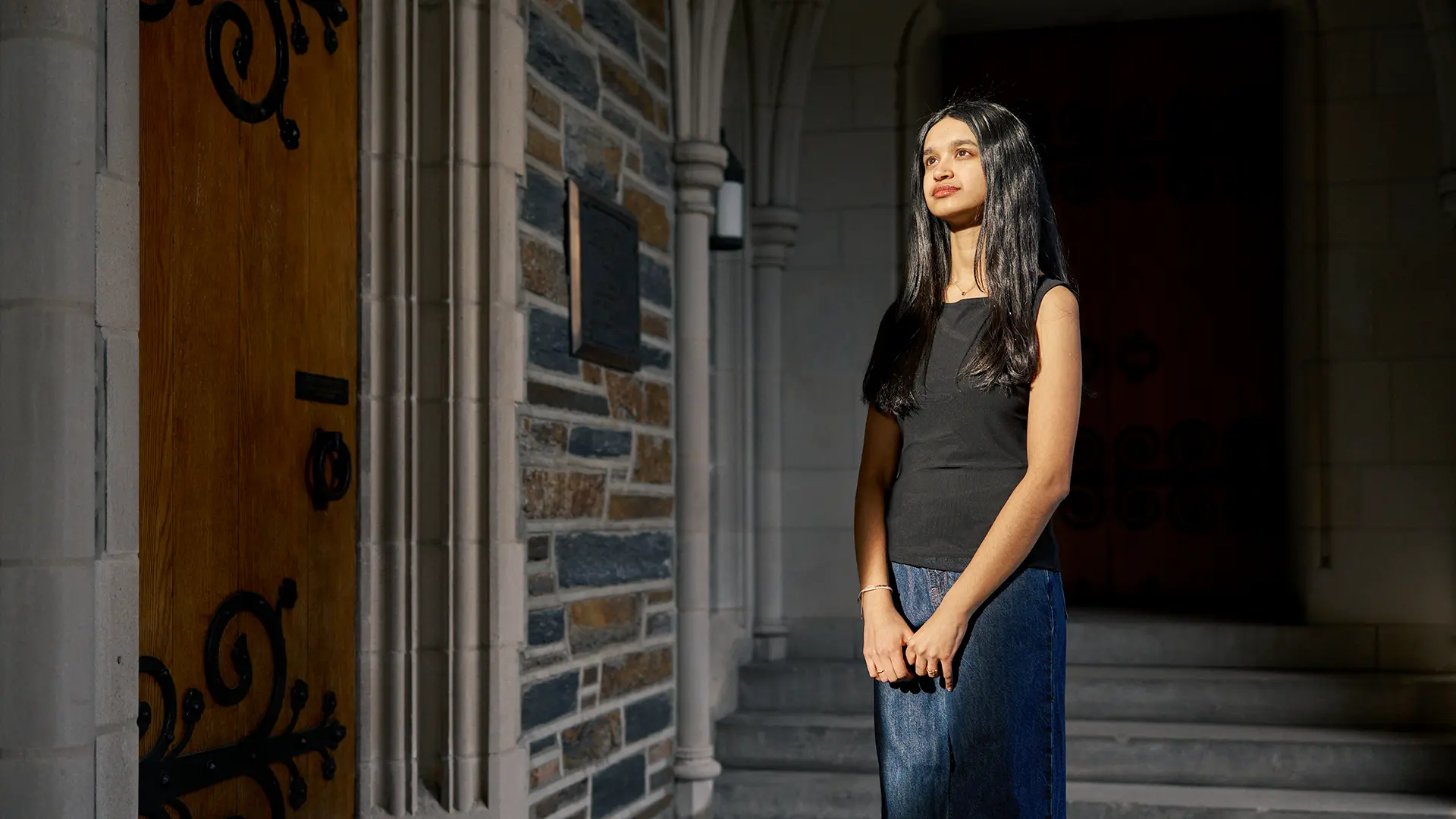
Duke University senior Trisha Santanam serves on the National Humanities Center’s National Humanities Leadership Council. A Mellon Mays Undergraduate Fellow and a Duke Trinity Scholar, Santanam majors in English and minors in Music. She examines how music allows people to “hear diaspora and discern a sense of home.” In this interview, Santanam talks about internalizing the influence of her humanities professors, working with the NHC to create a literary conference for local universities, and carrying on the legacy of higher education research and teaching.
NHC: You said in a previous interview that you are “interested in what music does and not just what it says.” Would you elaborate on that idea?
Trisha Santanam: My mother and grandmother raised me by telling stories about India in the form of songs. The songs were about women who gave food to lost travelers despite the hunger stirring in their own bellies—stories about children who left home and returned years later. Too young to grasp the weight of their voices, I only knew that the songs took me back to a version of India that lingered so frequently and abstractly in my mind. I became obsessed with music because of how it seemed to evade all description: what I felt when listening to a song could never be precisely translated, and I understood that there was something mysterious occurring that could only be experienced rather than explained.
At Duke, I took a class on the music and literature of the US South that showed me how a song could deepen my experience of the world. When my professor played Robert Johnson’s blues song, “Hellhounds on My Trail,” I felt porous and open to the world. I sat still, my musical senses broken and bursting with a new, shimmering light, as Johnson sang: “I got to keep movin’, I’ve got to keep movin’, blues fallin’ down like hail, blues fallin’ down like hail.” As I listened to his syncopated strumming and rough, elongated vowels, I realized that folk music was not dissimilar from the songs of my childhood; these were songs that explored the sense of loss that accompanies leaving home. I saw in American folk musical traditions the kind of messages that rang true for a multitude of peoples and cultures: it was about making room for sorrow without running away from it.
As I listened to more oldtime songs, I realized that music was a form of sonic expression that possessed a variety of subsurface feelings and meaning. We encounter all sorts of people and places and moods that estrange us from ourselves and the things we think we know. In music, I found exciting contradictions: it was about the combination of logic and soul, of mind and body, of hermeneutics and erotics.
Understanding that music is an embodied experience debunks the idea that bringing music into the literature classroom necessitates some kind of prior knowledge in formal musical analysis. The brilliant Bob Dylan puts it best in his Philosophy of Modern Song, a collection of strange and mysterious essays about popular music that obscure as much as they reveal. “Take two people,” he writes. “[O]ne studies contrapuntal music theory, the other cries when they hear a sad song. Which of the two really understands music better?” Dylan understands that music is valuable for what it “does” and not simply what it “says” or looks like on the page. This is different from a common way of talking about music that insists that value and meaning comes from purely lyrical composition, the complexity of the musical score, or the biography of the writer or performer.
While I’ve been classically trained in flute and piano since the age of four, I’m not of the belief that we need to understand the chord progression or the key of the piece to understand what the music is doing. There are plenty of ways that we process music that isn’t just cerebral: music lives in our bodies. We sway our heads, snap our fingers, and feel tears well in the corners of our eyes.
Who I am as an academic is not separate from who I am as a teacher or human in the world.
NHC: Please describe the influence of your English and music professors in your work and how you think about approaching your future work.
TS: I would not be the same human or scholar without the mentorship of faculty members in the Department of English at Duke. A lot of what I have internalized about the value of literature and music is because of Dr. Taylor Black. I have taken more of his courses than I can count—ranging from classes on Southern literature to ones on icons in American musical culture—and they have completely changed the way I experience the world. Dr. Black showed me the benefits of engaging with a text while remaining open to mystery and encouraged me to question methods of interpretation that set out to extract determinate meanings. It is because of him that I embrace contradictions, in life and in musico-literary texts, and feel capable of pursuing an interdisciplinary intellectual project in graduate school.
My view of the humanities is also heavily influenced by Dr. Priscilla Wald, who taught me to see how studying the humanities is also a study of what it means to be human. She has shown me that being a teacher doesn’t mean training your students to think in a robotic, predetermined way; instead, it is about giving students a framework to embrace uncertainty, which means giving them the space necessary to be messy and imperfect. Both inside and outside the classroom, Professor Wald models a kind of endless generosity with her time and knowledge that I can only hope to recreate with my own students one day.
I’ve also been lucky to work closely with Dr. Ranjana Khanna and Dr. Tsitsi Jaji. I’ve learned from Dr. Khanna, the Director of the Franklin Humanities Institute at Duke, how to advocate for the value of the humanities and organize collaborative spaces to do such work. Dr. Jaji’s openness to interdisciplinary methodologies, and her work in both critical and creative literary realms, influenced my understanding of how literature has a whole life beyond the page.
Together, those four professors, along with numerous other faculty members in various departments, have made me realize that who I am as an academic (as a researcher) is not separate from who I am as a teacher or human in the world. They reject any kind of hierarchical framing in the classroom, learning from and with their students. I feel an overwhelming sense of gratitude when I think about their influence on my being and becoming: whether they are attending my academic presentations, hosting mock interviews, or offering to go on a walk and talk through my latest research conundrum, my professors have shown me the importance of supportive academic communities. Just as lineages are an important topic in my research, so too are they important in my personal and academic life.
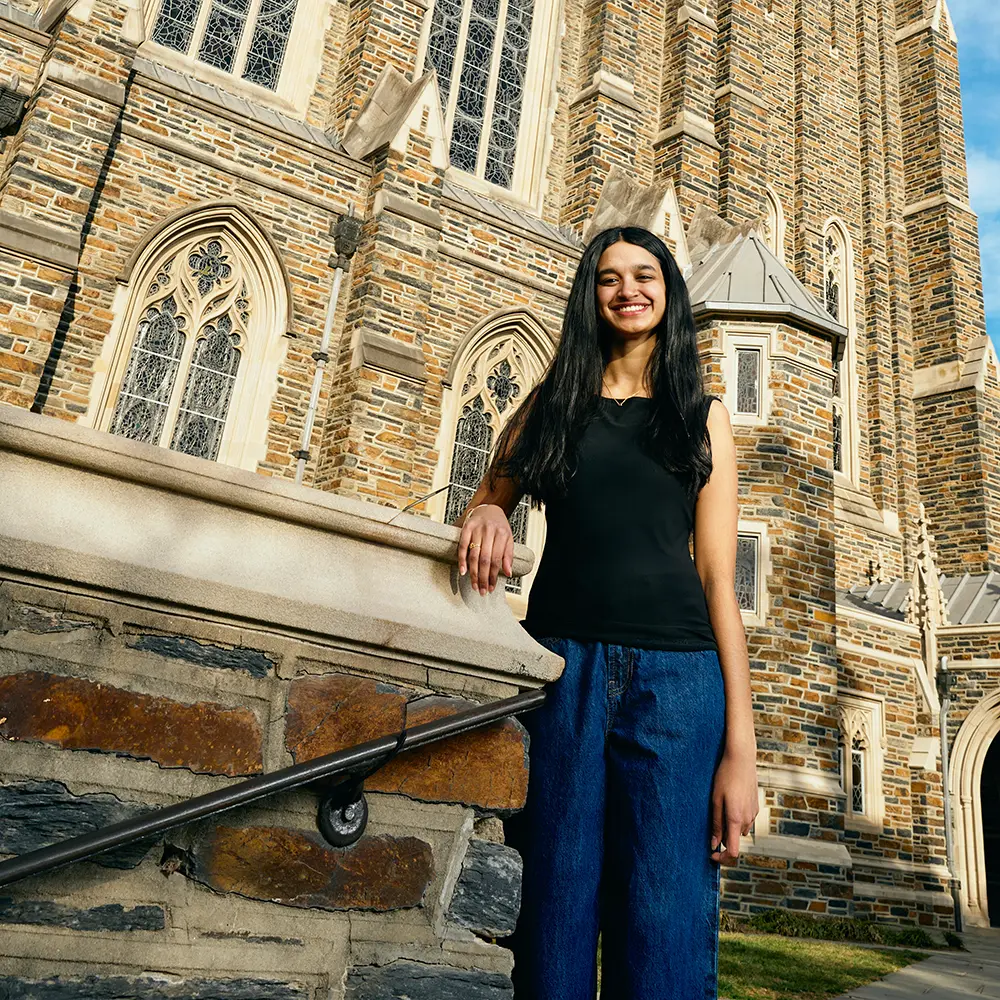
I think frequently about how I can replicate the wonderful mentorship I’ve received, especially as I get closer to leaving Duke and joining another academic community. I feel driven by my faculty’s endless support and guidance to be a similar kind of generous, open, and curious scholar and teacher.
NHC: What project are you working on now? What are your plans for the future in terms of academics and a career?
TS: My current project is working on my senior honors thesis, which explores the exchanges and encounters between various American authors, blues musicians, music critics, and visual artists to examine the production of “folk” art. This fall (2026), I’ll be pursuing a PhD in English, where I will continue my investigation into the literary and musical traditions of the United States from the late nineteenth century to the contemporary moment. My goal is to research and teach literature and music in a way that embraces the dissonant and contradictory aspects of American culture.
In my scholarship and pedagogical methods, I will continue to advocate for an interdisciplinary approach to literature. I plan to stay engaged in public-humanities endeavors, and I’m looking forward to becoming part of new collaborative, exploratory academic communities through graduate study. My desire to pursue a PhD is not only to expand my understanding of American literature and music: I hope to carry on the tradition of the faculty who have helped nurture the person I am both inside and outside of the classroom.
The humanities encourage us to reject the first, easy answer and to embrace uncertainty. They ask us to think more critically and ethically about the communities we are part of, and our place within them.
NHC: There’s a notion that young people don’t care about the humanities anymore; that somehow the humanities are obsolete. You and your work debunk that myth. What do the humanities mean to you, and why do the humanities remain important and relevant?
TS: The humanities heighten our experience of being human and show us that there are so many different ways of perceiving the world. As people become increasingly reliant on artificial intelligence to make sense of things—to think and write and speak for them—the humanities remind us of the importance of a natural, messy, and unpredictable kind of human intelligence.
The humanities encourage us to reject the first, easy answer and to embrace uncertainty. They ask us to think more critically and ethically about the communities we are part of and our place within them. Engaging with the humanities helps us to expand our powers of perception and interpretation as we go about the world. Most people engage with the humanities every single day, whether they realize it or not. We don’t just engage with the humanities when we read books in classrooms or attend a lecture on some niche topic. When we talk about film techniques with friends during movie nights, attend a concert, go to an art museum, or read for fun, we weave the humanities into everyday life. One of the reasons I love doing public-facing humanities work is because it frames these experiences differently, and we start to realize that the humanities are present in every nook and cranny of our lives.
The National Humanities Center emphasized the idea that humanities work doesn’t need to just have one outlet or be one particular thing, encouraging us to explore where our interests took us within and beyond the classroom.
NHC: Tell us about your service on our National Humanities Leadership Council (NHLC). What does serving in this capacity mean to you, especially in terms of your influence on the future of humanities studies and your ability to find community in the space NHC creates?
TS: I knew coming to Duke that I wanted to study English and music, using literary and musical texts and experiences to hone my way of being in and seeing the world. When I heard about the National Humanities Leadership Council, I realized it would give me the opportunity to emphasize the importance of the humanities outside of the classroom in a collaborative way. The council provided me with the resources necessary to work with and learn from the National Humanities Center, an institution that prioritizes public-facing humanities work, helping others realize the importance of the humanities to our experience of life itself.
My project for the NHLC was related to the Triangle Undergraduate Literary Conference (TULC), an undergraduate literary conference for Duke, UNC-Chapel Hill, North Carolina Central University, and North Carolina State University, which I co-created and co-organized in February 2025. During my participation in the council, I was able to receive mentorship from the NHC’s vice president for public engagement, Jacqueline Kellish, and June Ke. With their support, I co-organized the second annual TULC and secured funding and speakers for the conference. I was also encouraged to think about the future of TULC and the importance of continuity in humanities initiatives: I created a variety of conference-related materials for future students in Duke English to use if they wished to develop an undergraduate conference.
What is most valuable to me about the NHLC experience is that it gave me the space and resources necessary to engage deeply in a humanities project. The NHC emphasized the idea that humanities work doesn’t need to just have one outlet or be one particular thing, encouraging us to explore where our interests took us within and beyond the classroom. When I examine the value of “exchanges” and “encounters” between various authors and musicians in my scholarship, I’m cognizant about how that rings true in my own life, too. Being a part of the National Humanities Leadership Council allowed me to form valuable relationships with other students passionate about the humanities, as well as scholars and staff at the National Humanities Center who have devoted their life to advocating for the humanities.