
Featured Research
Points of View
For what you see and hear depends a good deal on where you are standing: it also depends on what sort of person you are.
–C. S. Lewis, The Magician’s Nephew
Featured Projects

Alexis Pauline Gumbs
A Homemade Field of Love: June Jordan and Fannie Lou Hamer Solve the Energy Crisis

Peter R. Kalb
Apollo’s Gift: An Art History of the Moon Landing

Despina Stratigakos
Ghost Gardens
A Homemade Field of Love: June Jordan and Fannie Lou Hamer Solve the Energy Crisis
Alexis Pauline Gumbs
Independent Scholar, Languages and Literature
Alexis Pauline Gumbs is a community-cherished Black feminist scholar and author. Dr. Gumbs received her BA in American studies from Barnard and her PhD in English, Africana Studies, and Women and Gender Studies from Duke University. She is the author or editor of seven books, including Revolutionary Mothering: Love on the Front Lines (PM Press, 2016), Spill: Scenes of Black Feminist Fugitivity (Duke Press, 2016), Undrowned: Black Feminist Lessons from Marine Mammals (AK Press, 2020), and Survival is a Promise: The Eternal Life of Audre Lorde (Farrar, Strauss and Giroux, 2024). Her current project considers how the perspectives of Black feminists June Jordan and Fannie Lou Hamer can reshape thinking and connect ideas about and between cultural and political movements.
NHC: What was the initial spark that led you to this project? What are the big questions that you are considering?
APG: What is earth for? Over the past 50 years, a growing use for rural land in depressed communities is the building of prisons, despite lowering crime rates. In the past five years, the noticeable land grab is for water-guzzling data centers, in the midst of a water and energy crisis. How did we get here, to a place where our dominant systems sacrifice not only our relationship to earth but our chance of surviving here to huge corporations that, in one instance, cage human beings and in the next make us obsolete as a species? As a Black feminist scholar, I blame it on the fact that our movements, our policy makers, and our academic disciplines have ignored the ecological warnings and strategies of Black feminists for the past 50 years. My project looks at the ecological models proposed by Fannie Lou Hamer and June Jordan as a solution.
NHC: In the course of your research, have you run across anything that genuinely surprised you? What can you tell us about it?
APG: Many people are also surprised that the poet June Jordan writes about trees, plants, the ocean, and the moon in her most political poems, but that is because of a false whitewashing of the environmentalist impulse in the literary imagination. What was more surprising to me was how long it took me to realize that my two favorite writings by June Jordan ([her essay] “The Creative Spirit” and “1977: Poem for Mrs. Fannie Lou Hamer”) were both written in 1977 and both center around the lilies of the field. My project takes two phrases, the assertion that “love is lifeforce” and that Fannie Lou Hamer is “one full Black lily luminescent in a homemade field of love.” What is a field? In the environmental sense, the academic sense, the astrophysical sense? And how can we mobilize love to solve the energy crisis of our time?
NHC: What new avenues of inquiry do you hope this research will prompt or make possible in your field?
APG: I hope more people will study and illuminate the continuities between twentieth-century movements, especially the Civil Rights Movement and the Black Feminist Movement and the ecological movement. I also hope we will collectively be able to imagine our “fields” in the most generous way possible. So that they will feed generations.
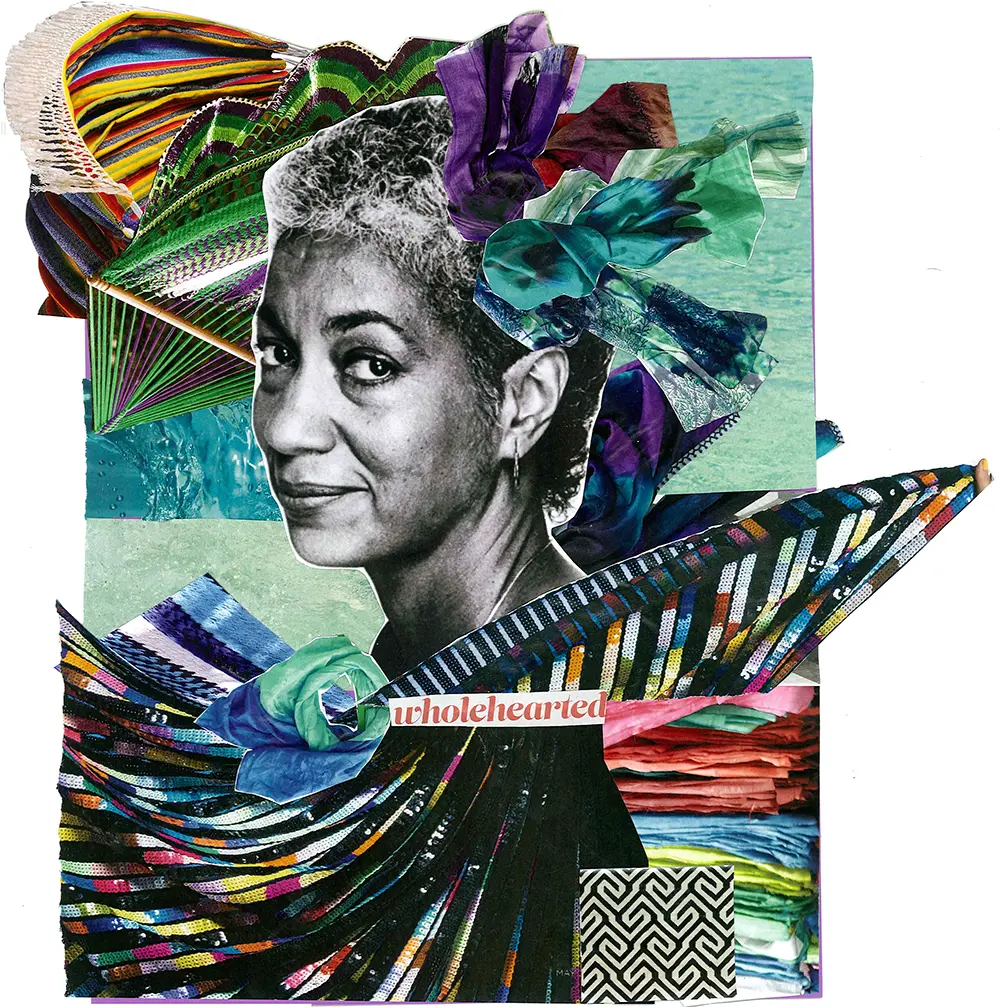
Collage: Wholehearted for June Jordan, by Alexis Pauline Gumbs.
Apollo’s Gift: An Art History of the Moon Landing
Peter R. Kalb
Associate Professor, Cynthia L. and Theodore S. Berenson Chair of Contemporary Art, Brandeis University
Peter R. Kalb holds the Cynthia L. and Theodore S. Berenson Chair of Contemporary Art History in the Fine Arts Department at Brandeis University, where he also serves in the Women’s, Gender, and Sexuality Studies Department. Kalb is the author of Art Since 1980: Charting the Contemporary that examines political and aesthetic trends in today’s art world and draws on over twenty years of teaching and research. His current book project, Apollo’s Gift: An Art History of the Moon Landing, explores responses by artists working around the world to humanity’s transformation into a space-faring species.
NHC: What was the initial spark that led you to this project? What are the big questions that you are considering?
PK: My research asks, “What did the Apollo moon landing help artists see about their world and what does their work help us see about ours?” I was born in Ohio in 1968, swear I saw a moon landing on TV, and, like many of my generation, feel connected to Apollo. As an art historian, it is the critiques of modernism, power, and society in the art and thought of the sixties that inspire me. These two don’t fit well together, and I was excited to find artists active during the mission years grappling with how to relate the radical ideas of the era to its technological accomplishments. These works might help us to understand the essence of humanity’s new spacefaring identity. The project was never fully completed, but as Apollo took astronauts to the moon, it led artists to critical analyses of mass media, technology, the senses, and citizenship.
NHC: In the course of your research, have you run across anything that genuinely surprised you? What can you tell us about it?
PK: I couldn’t believe there wasn’t more art about Apollo. Humans entered the most alien and distant realm ever experienced, and museums didn’t fill with new forms of space art. Why? Also surprising was how often journalists, artists, philosophers, and others deeply invested in understanding Apollo just threw up their hands. After the last lunar mission, The New York Times offered the disappointing assessment: “Meaning of Apollo: The Future will Decide.”
Alternately, in the 1960s art world that valued allegiance to singular methods, styles, and messages, Apollonian art was overflowing! We see abstraction, mimesis, expressionism in painting, photography, film, installation, performance … addressing technology, human nature, politics, spirituality, nationalism, internationalism … It’s as if the precision of space travel prompted artistic excess.
NHC: What new avenues of inquiry do you hope this research will prompt or make possible in your field?
PK: NASA failed to anticipate the consequences of lunar travel because they found no tools to create social impact studies. The social sciences responded, as has the growing field of space humanities. My work reveals a trove of artistic research related to aerospace innovation and offers methodological entries to it grounded in the visual arts. Aerospace technology was neither a new church to which artists offered piety for patronage, nor a cause to promote; artworks became sites to dissect and examine the identity and impact of Apollo. I hope my work provokes interdisciplinary analyses of relationships between art, technology, science, and society while showing the importance of art history to engaging the image-, object-, and sensation-based communication essential to the Apollo mission and gaining importance in today’s space age.
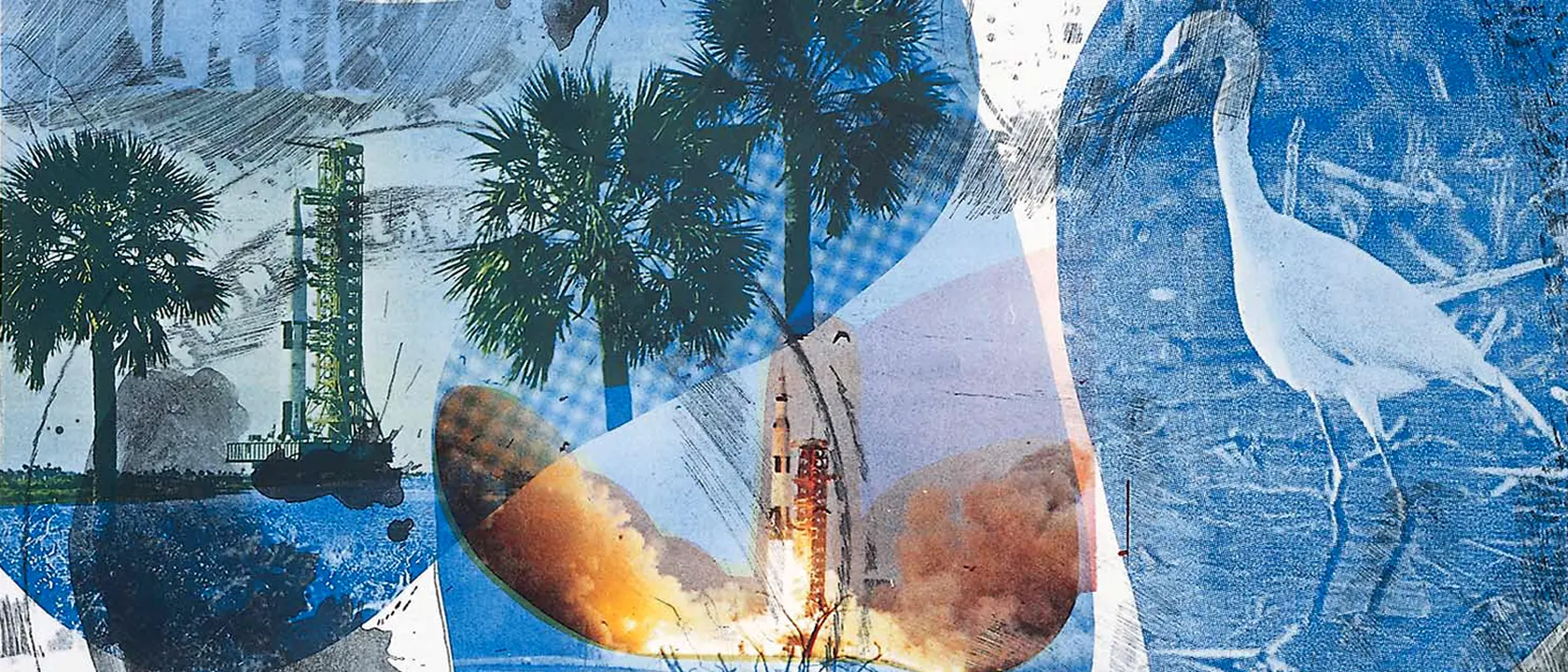
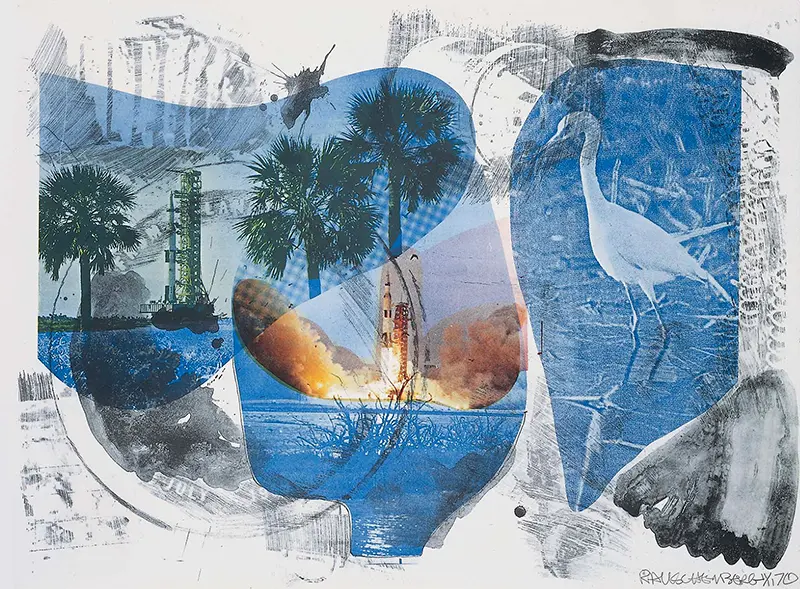
Robert Rauschenberg, Local Means (Stoned Moon), 1970, lithograph 32 3/8″ x 43 1/4″ (82.2 x 110 cm), from an edition of 11, published by Gemini G.E.L., Los Angeles RRF 70.E005. Rauschenberg created this print as part of his Stoned Moon series with materials collected during his visit to the Kennedy Space Center for the launch of Apollo 11. It captures some of the diverse themes artists incorporated as they sought to understand the impact of space travel on what it means to be human.
Ghost Gardens
Despina Stratigakos
SUNY Distinguished Professor of Architecture, University at Buffalo
Despina Stratigakos, a SUNY Distinguished Professor of Architecture at the University at Buffalo, is a historian and writer who explores how power and ideology shape the built environment. Her research ranges from the creation of domestic spaces to the architecture of world empires. Her current book project tells the stories of Western ghost towns from the perspective of the plants that humans left behind.
NHC: What was the initial spark that led you to this project? What are the big questions that you are considering?
DS: Like a scene from a fairy tale, the project began with a solitary apple tree deep within the forest. The Shasta-Trinity National Forest of Northern California is a dense expanse of conifers and hardwoods, making this non-native tree—isolated and far from any trail—a startling intruder. My local guide explained that plants cultivated by Gold Rush miners and homesteaders often outlive the original settlements. This discovery sparked my search for vegetal survivors of American West ghost towns. Can we truly consider such places dead or empty when the plants left behind by humans continue to flourish, evoking memories and stories of their own?
NHC: In the course of your research, have you run across anything that genuinely surprised you? What can you tell us about it?
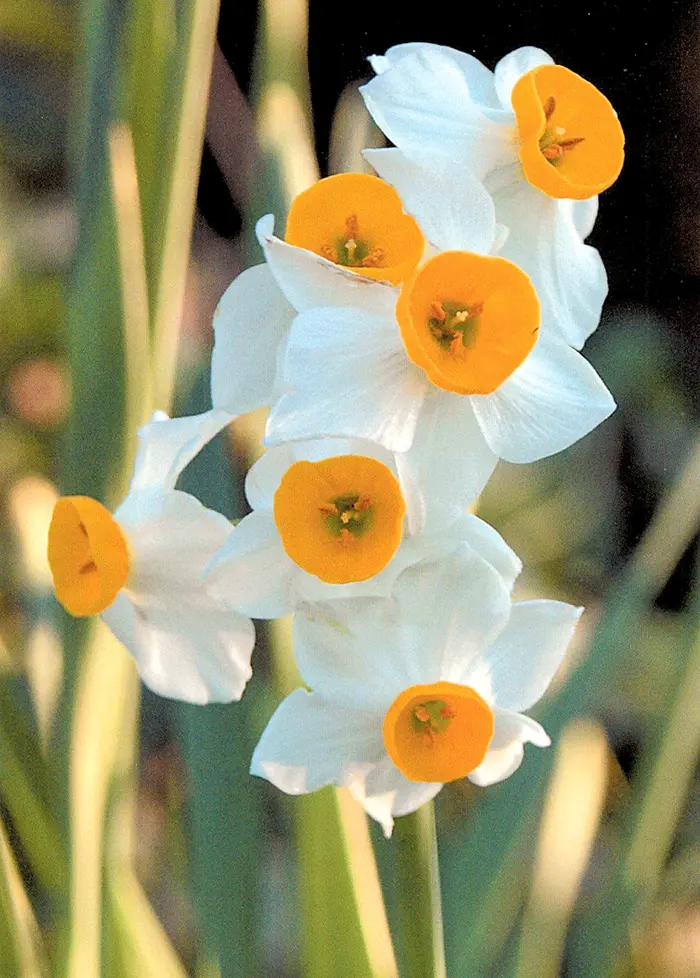
DS: I am struck by the resilience of abandoned cultivated plants and how they make us think differently about ghost spaces. Take the Chinese sacred lily brought by Chinese gold miners from Asia to Northern California in the 1850s to celebrate the Lunar New Year. After these immigrants were violently expelled from Shasta County in 1859, the flowers remained and today continue to grow in the ruins of historic buildings, reminding us of the people driven from their homes.
NHC: What new avenues of inquiry do you hope this research will prompt or make possible in your field?
DS: What would a history of abandoned cities or architecture look like if told from the perspective of the plants humans left behind? Can we tell architectural histories from a non-human perspective?
Chinese Sacred Lilies growing in Shasta, California. Photograph by Pacific Horticulture contributor Donn L. Todt.
Share this page
Learn More
Featured Research
HBCU Scholars
Aug 5, 2026
Highlighting the research of Fellows who are part of the Center’s ongoing initiative to support scholars from Historically Black Colleges and Universities.
Featured Research
African American Creators
Jul 1, 2026
Black Americans have shared their experiences and perspectives across creative genres and challenged how we think about music, fiction, and art.