5.
 |
Nigeria
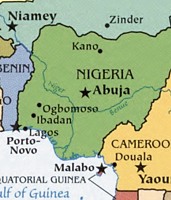
About one fifth of the enslaved Africans brought to colonial America and the United States were from the regions known in the slave trade as the "Bight of Benin" and the "Bight of Biafra," referring to the large coastal bays to the south of present-day Togo, Benin, Nigeria, Cameroon, and Gabon. Here we read two distinctive perspectives of the region (specifically present-day Nigeria)—one from an African-born Ibo (perhaps) who was transported to America as a slave, and one from a Caribbean-born free black American who travelled to Africa, his "motherland," to promote the settlement of emancipated slaves.
- Olaudah Equiano describes his Ibo homeland. As a child in the mid 1750s, Olaudah Equiano was captured by slave traders and purchased by two ship captains before buying his freedom in 1766 and ultimately settling in England. In 1789 he published his famous autobiography, The Interesting Narrative of the Life of Olaudah Equiano, from which we read his description of the Ibo homeland in present-day southeastern Nigeria. While there is evidence that Olaudah was not born in Africa, but in South Carolina (see Supplemental Links), historians consider his description of the kingdom of Benin (not the current nation of Benin) to be accurate, perhaps gained—if he was not born in Africa—from conversation with African-born slaves and from reading published accounts by European travellers in Africa.
- Robert Campbell visits his "motherland." The African American abolitionists Robert Campbell and Martin Robinson Delany travelled to present-day southwestern Nigeria in 1859-1860 to negotiate with tribal leaders concerning the potential settlement of freed slaves from the United States. Campbell's account of the journey, A Pilgrimage to My Motherland: An Account of a Journey among the Egbas and Yorubas of Central Africa in 1859-60, includes detailed description and commentary on the Ibo and Yoruba people. (Campbell's "motherland" is Africa; he does not indicate knowledge of his parents' ancestry.) No resettlement project resulted from their trip, partly due to the emigration controversy among American blacks (see IDENTITY: Emigration), and partly due to impending civil war in America. For himself, Campbell asserts in his preface that "I have determined, with my wife and children, to go to Africa to live."
How does Campbell's account, the only narrative in this theme FREEDOM by a free-born non-African black American, compare with the narratives from enslaved African-born men (assuming Olaudah was born in Africa)? (18 pages.)
Discussion questions
- What overall impressions do you receive from the accounts by Olaudah and Campbell?
- How do Olaudah and Campbell emphasize the freedom and self-determination of the Africans?
- How do they use their accounts to encourage white respect for Africans and African Americans?
- How does Campbell's account, the only narrative in this theme FREEDOM by a free-born non-African black American, compare with the narratives from enslaved African-born men (assuming Olaudah was born in Africa)?
- Compare Olaudah's and Campbell's descriptions of the tribal groups of present-day Nigeria. What tone and commentary do you find in both? What most differentiates their accounts?
- What analytical tools would historians and anthropologists use to determine the origin and validity of Olaudah's description?
- How does the fact that Olaudah's birthplace is uncertain influence your reading of his description of Ibo culture?
- Might Olaudah have considered returning to Benin (or visiting for the first time) after his emancipation? Why or why not?
- Why do you think that Campbell, who was born on the Caribbean island of Jamaica, desired to emigrate to Africa after his journey?
- In what ways does Campbell endorse African American colonization projects through his discussion of the Yoruba?
- How would Martin Delany and Henry Highland Garnet, other proponents of African American settlements in Africa, have responded to Campbell's account? (Delany's account of his own trip of the same time includes little reference to African people of the time.)
|
Printing
| Olaudah Equiano: | 9 |
| Robert Campbell: | 9 |
| TOTAL | 18 pages |
|
Supplemental Sites
The Interesting Narrative of the Life of Olaudah Equiano, 1789, full text in Documenting the American South (University of North Carolina at Chapel Hill Library)
Where was Olaudah Equiano born? (and why does it matter?), from Brycchan Carey, Surrey University, UK
Robert Campbell, A Pilgrimage to my Motherland, 1861, full text (as pdf) in Open Library
The Trans-Atlantic Slave Trade, in In Motion: The African-American Migration Experience, from the Schomburg Center for Research in Black Culture (New York Public Library)
U.S. Slave Trade, in The Abolition of the Slave Trade: The Forgotten Story, from the Schomburg Center for Research in Black Culture (NYPL)
Timeline of Art History: Guinea Coast, 1600-1800 A.D. (present-day Sierra Leone, Guinea-Bissau, coastal Guinea, Liberia, Côte d'Ivoire, Ghana, Togo, Republic of Benin, and Nigeria)
|
Images:
-U.S. Central Intelligence Agency, Africa, map, 2008, detail. Courtesy of the Library of Congress, Geography & Map Division, Call. No. G8200 2008 .U5.
- An Ibo man with ichi, or tribal marks, photograph (detail) in G. T. Basden, Among the Ibos of Nigeria, 1921. Courtesy of the Schomburg Center for Research in Black Culture (New York Public Library), #1107152.
- A Mohammedan [Muslim] Yoruba trader, Oyo, Nigeria, illustration (detail) in Elisée Reclus, The Earth and its Inhabitants: Africa, 1889. Courtesy of the Schomburg Center for Research in Black Culture (New York Public Library), #1105150.
|
| *PDF file - You will need software on your computer that allows you to read and print Portable Document Format (PDF) files, such as Adobe Acrobat Reader. If you do not have this software, you may download it FREE from Adobe's Web site. |
|