3.
 |
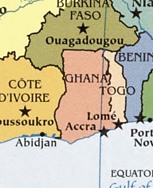
Ghana
Broteer Furro (named Venture by his first slaveholder) was born around 1729 in or near present-day Ghana, the son of "Saungm Furro, Prince of the Tribe of Dukandarra." (Scholars have not identified his ethnic group.) As a young boy he was captured, transported to Barbados, and enslaved for about twenty-five years in New York and Connecticut before purchasing his freedom and, one by one, the freedom of his wife and children. In 1798, in his late sixties, he narrated his first-person memoir to Elisha Niles, an anti-slavery activist. In the first chapter of A Narrative of the Life and Adventures of Venture, a Native of Africa, he describes his early life, his separation and reunion with his family, and his family's capture, asserting that he will "inform my reader what I remember concerning this place."
Venture Smith died in Connecticut in 1805. Two centuries later, in 2006, the remains of Smith and his wife were exhumed by a team of archaeologists in the Documenting Venture Smith Project (see Supplemental Links). Although their bones were too dissolved to provide sufficient DNA for analysis, their known living descendents are participating in the continuing project to identify America-Africa genetic links from the era of slavery. (6 pages.)
Discussion questions
- Overall, what do we learn of Broteer Furro's homeland from chapter one of his narrative?
- What evidence would you use to trace his geographic and ethnic roots in Africa?
- From the entirety of Broteer Furro's narrative, how did he define freedom before and after enslavement, as far as you can determine?
- How might Smith's childhood in Africa, during which he was separated from and reunited with his family, have influenced his response to enslavement?
- Although Venture Smith (Broteer Furro) narrated his memoirs to Elisha Niles, the first-person "I" in the narrative is Smith, whereas in the narratives of Ayuba, Rahman, Brinch, and Baquaqua, the narrators are the white anti-slavery activists who published the narratives (see FREEDOM #1, #2, and #4). How does the identity of the narrator influence the narratives' content and the readers' responses?
- Like Smith's narrative, that of Olaudah Equiano is a first-person narrative by a former slave. Analyze the effect of intermediary-free memoirs and compare them with "as told to" narratives? What are the advantages and disadvantages of each?
- Smith and Olaudah purchased their freedom and wrote first-person narratives. Might there be a correlation between the mode of each man's emancipation and the voice of his narrative? (Don't push this too far, though.)
- Imagine a conversation between Smith and Olaudah. What would they find most similar in their life experiences? What would they choose to emphasize to 21st-century readers?
- Extend this inquiry to all the narratives: how did their African lives influence their response to enslavement, as far as you can determine?
|
Printing
| Broteer Furro (Venture Smith): | 6 |
|
Supplemental Sites
A Narrative of the Life and Adventures of Venture, a Native of Africa, full text in Documenting the American South (University of North Carolina at Chapel Hill Library)
Venture Smith, on his life in New York and Connecticut, and on purchasing his freedom, in History Matters, from George Mason University and the City University of New York (CUNY)
Documenting Venture Smith, project of the Beecher House Center for the Study of Equal Rights and the Wilberforce Institute for the Study of Slavery and Emancipation
Venture Smith, the Black "Paul Bunyan," on the archaeological project in Connecticut, from NPR
Science and Slavery, on the archaeological project, from the British Science Association
The Trans-Atlantic Slave Trade, in In Motion: The African-American Migration Experience, from the Schomburg Center for Research in Black Culture (New York Public Library)
Peoples from Senegambia, Benin and the Gold Coast, in The Abolition of the Slave Trade: The Forgotten Story, from the Schomburg Center for Research in Black Culture (NYPL)
Timeline of Art History: Guinea Coast, 1600-1800 A.D. (present-day Sierra Leone, Guinea-Bissau, coastal Guinea, Liberia, Côte d'Ivoire, Ghana, Togo, Republic of Benin, and Nigeria)
|
Images:
-U.S. Central Intelligence Agency, Africa, map, 2008, detail. Courtesy of the Library of Congress, Geography & Map Division, Call. No. G8200 2008 .U5.
-Gravestone of Venture Smith, Haddam Neck, Connecticut, 2006, photograph by J. L. Briggs; permission pending. |
| *PDF file - You will need software on your computer that allows you to read and print Portable Document Format (PDF) files, such as Adobe Acrobat Reader. If you do not have this software, you may download it FREE from Adobe's Web site. |
|