7.
 |
"The White Man's Burden" and Responses
| - | Rudyard Kipling, "The White Man's Burden," poem, McClure's Magazine, February 1899 |
| - | American Missionary Assn., "The White Man's Duty," editorial, The American Missionary, July 1899 |
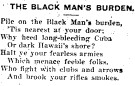
| - | H. T. Johnson, "The Black Man's Burden," poem, Christian Recorder, March 1899 |
| - | T. Thomas Fortune, "The White Man's Burden," editorial, New York Age, April 1899, excerpts |
| - | Benjamin R. Tillman, Address to the U.S. Senate, 7 February 1899, excerpts |
|
|
Rudyard Kipling's poem "The White Man's Burden" appeared in McClure's Magazine in February of 1899, within days of the beginning of the Philippine-American War and Senate ratification of the treaty ending the Spanish-American War. The poem quickly became a touchstone in the growing debate over America's role in the world. Urging steadfastness in the face of failure, forbearance in the face of slander, and generosity in the face of ingratitude, it evoked strong responses. The American Missionary Society praised it for expressing "a large and fundamental truth." Parodies linked it to such domestic issues as labor and race. Editorials by African American journalists attacked it as hypocrisy. South Carolina's Senator Tillman even managed to turn it into a warning against imperialism. Its mixture of noblesse oblige, high motives, and racial superiority will evoke strong responses even today. 9 pages.
Discussion questions
- How does Kipling portray the subjects of colonial rule?
- How does he portray their rulers?
- What motives does he offer for imperial rule?
- How do the responses link it to domestic issues?
- How does Roosevelt's "The Strenuous Life" echo "The White Man's Burden"?
- How does the memory of the Civil War color responses to the poem and to America's role in the world?
|
» Link |